

Schooner Barge
Built: 1868, Lafrinier and Drake Company, Cleveland, Ohio
Length: 182 feet
Lost: August 23, 1928
Discovery: Located by divers shortly after the 1928 sinking
Location: N 43° 29.898′, W 086° 29.892′, off Whitehall, Michigan
Depth: 75 feet
HISTORY OF THE SHIP
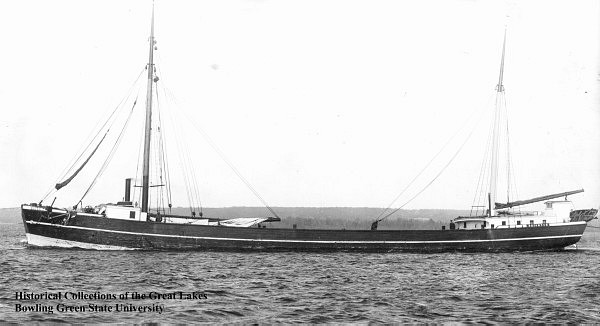
The Brightie, also known as the Brighty, was built in 1868 at Cleveland, Ohio, by the Lafrinier and Drake Company under the supervision of Ira Lafrinier. H. J. and R. K. Winslow commissioned the vessel, which they named for H. J. Winslow’s daughter, who had died in Europe.
At 182 feet long, 33 feet 6 inches in beam, and 15 feet deep, the Brightie ranked among the larger sailing vessels of its day. It measured approximately 600 tons and could carry as much as 40,000 bushels of corn. Construction cost approximately $45,000.
The vessel incorporated several contemporary improvements, including a patent centerboard winch. Its large deck cabin was described at the time as “a fine piece of workmanship which is large and airy.” Six masts and topmasts gave the vessel an extensive sail plan: the foremast stood 96 feet high, the fore-topmast 67 feet, the mainmast 98 feet, the main-topmast 67 feet, the mizzenmast 88 feet, and the mizzen topmast 56 feet.
Trouble followed the Brightie almost immediately. Within three months of its first voyage, the vessel grounded at Point Pelee in Lake Erie. After remaining stranded for several hours, it freed itself and continued its voyage.
Less than a year later, the Brightie grounded at Point Pelee again. Eleven months after that incident, it collided near Racine, Wisconsin, with the schooner Louisa McDonald. In December of the following year, the vessel grounded at Washington Island and required a tow from the schooner Leviathan to reach port.
By 1886, changing technology and the vessel’s age had altered its role. Workers removed the mainmast, and the Brightie entered service as a tow-barge rather than a sailing vessel.
Its difficult career continued. In 1886, the vessel lay in port when the Rust struck its starboard bow, cutting the barge down to the waterline. Although the collision caused substantial damage, the Brightie survived and continued working.
In 1905, the Brightie and the barge Goshawk were being towed by the steamer Bradley near Squaw Island on the Niagara River when the towline parted. The two lumber-laden barges drifted toward the American shore and threatened to strike a pier.
Captain Robert McMurray of the tug International responded quickly. He first secured the Brightie and began towing it away from danger, but the barge soon lost its rudder. McMurray beached the Brightie in the mud at Squaw Island and then turned his attention to the Goshawk. After securing the second barge, he maneuvered it through the bridge and returned it to the Bradley.
More than half a century after its construction, the Brightie remained in service as a lumber barge. By then, however, its wooden hull had endured decades of hard use, collisions, groundings, and exposure to the Great Lakes.
THE SINKING
On August 23, 1928, the Brightie was carrying a cargo of pulpwood on Lake Michigan off Whitehall, Michigan, when it foundered in what contemporary accounts described as only a mild blow.
Seven people were aboard. As water entered the aging wooden hull, its seams opened and the vessel began to take on water rapidly. The 60-year-old barge could no longer withstand the stress.
The Brightie sank in approximately 75 feet of water. One person died in the disaster.
The circumstances of the sinking are notable because the vessel did not disappear during a major gale or collision. Instead, decades of service had taken their toll on the wooden hull. Reports that the vessel’s “60-year-old hull just gave up” capture the essential nature of its final loss: the Brightie had survived numerous accidents during its long career, but ultimately succumbed to the deterioration of its aging structure while carrying a heavy load of pulpwood.
THE WRECK
The Brightie has deteriorated substantially during the nearly century since its sinking. Its wooden hull has broken apart, leaving scattered timbers and structural remains on the lake bottom.
The wreck’s shallow depth has exposed it to the continual effects of Lake Michigan storms, wave action, currents, and winter ice. These forces have progressively reduced the vessel to a dispersed archaeological site rather than an intact hull.