

Steamship
Built: 1881, Mechanics Dry Dock, Grand Haven, Michigan
Length: 230 feet
Lost: November 13, 1883
Discovery: June 2001 by Michigan Shipwreck Research Association
Location: N 42° 39.525′, W 086° 31.700′, off Saugatuck, Michigan
Depth: 275 feet
DISCOVERY
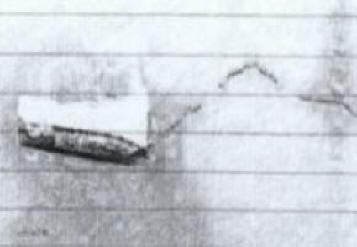
In June 2001, while searching Lake Michigan for the steamship Chicora, the Michigan Shipwreck Research Association (MSRA), working with side-scan sonar operator David Trotter, located a large steamship wreck in approximately 275 feet of water off Saugatuck, Michigan.
Working with ROV operator Keith Pearson, the team obtained video images of the hull that initially suggested the wreck might be the Chicora. A subsequent technical dive by Jeff Vos, however, revealed markings on a gauge that pointed to a different identity. The gauge carried the words “Boiler Works” and “Ferrysburg, Michigan,” providing an important clue that the wreck was the H. C. Akeley.
Vos returned to the wreck with Robert Underhill and Todd White. Their subsequent dives documented additional evidence that confirmed the identification.
HISTORY OF THE SHIP
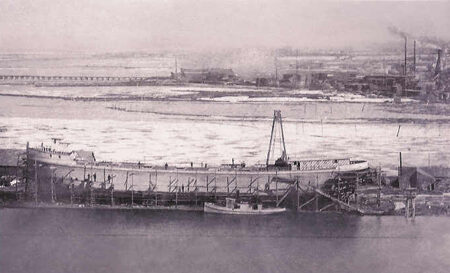
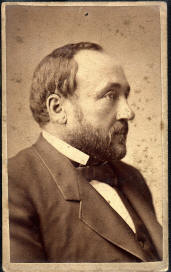
The H. C. Akeley was constructed at Mechanics Dry Dock in Grand Haven, Michigan, by Thomas W. Kirby and Healy C. Akeley. The vessel took its name from Akeley, a prominent Grand Haven businessman who arrived in the community in 1858 and played an important role in developing the region’s lumber and shipping industries.
The 230-foot wooden steamship cost more than $110,000 to construct. Launched in the spring of 1881, it carried three masts that assisted with cargo handling. The vessel ranked among the largest and most strongly built Great Lakes ships of its era.
The H. C. Akeley received its machinery from the wrecked tug General Paine. Originally constructed on the East Coast in 1865 as the USS Trefoil, the tug had later been transferred to the Great Lakes and renamed General Paine. It struck the Grand Haven pier in 1879 and became a total loss. The H. C. Akeley incorporated the tug’s machinery into its new construction.
The exact history of the boilers remains less certain. The gauge discovered by divers bears the words “Boiler Works” and “Ferrysburg, Michigan.” This evidence suggests that the machinery may have been retrofitted by the Johnston Boiler Works, a local company, although no surviving records confirm the work.
Despite extensive research, no construction plans for the H. C. Akeley have been located. Only one known photograph documents the vessel during its construction in 1880.
The H. C. Akeley carried freight for three seasons and operated profitably for its owners. In November 1883, it loaded approximately 54,000 bushels of corn in Chicago for delivery to Buffalo, New York.
Captain Edward Stretch commanded the vessel. A 45-year veteran of Great Lakes navigation, Stretch had previously sailed the brig Pamlico between Chicago and Europe and commanded the schooners Sunrise and Montpelier. He made Grand Haven his home.
On Sunday, November 11, 1883, Captain Stretch and a crew of 17 departed Chicago with the H. C. Akeley as the November gales intensified. Only 12 crew members would survive the disaster.
THE STORM AND SINKING
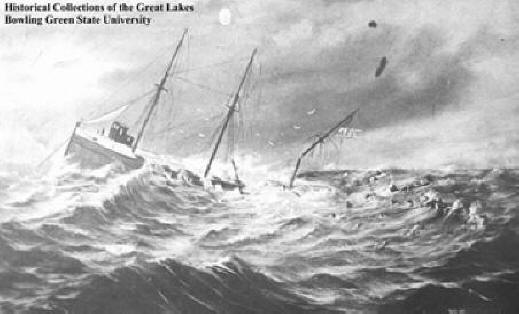
According to the survivors, the H. C. Akeley headed north near Milwaukee when it encountered the disabled tug Protection, which had been towing the schooner Arab. The Arab had sunk during the tow, damaging the Protection’s machinery.
The H. C. Akeley took the disabled tug in tow and continued north into the strengthening storm. The heavy strain eventually overwhelmed the steamship’s steering gear, and the wheelsman lost control. The crew cut the Protection loose, allowing the tug to fend for itself. The Protection later grounded near Saugatuck.
At approximately 10:30 p.m. on November 11, 1883, heavy seas tore away the feed pipe from the port boiler, releasing steam into the vessel. About an hour later, while working near the boiler, the engineer heard two sounds resembling gunshots. The guy chains supporting the smokestack had failed, causing the funnel to topple overboard.
Only the plenum that connected the two boilers to the smokestack remains visible on the wreck today. Because the H. C. Akeley continued drifting after the funnel went overboard, the smokestack itself may rest some distance from the wreck site.
The storm continued to intensify, and one of the vessel’s two lifeboats was torn away. A surviving lifeboat davit remains on the port side of the stern.
By Monday, November 12, the vessel’s condition had deteriorated further. Captain Stretch ordered the anchor set in an attempt to hold the H. C. Akeley against the storm. The starboard anchor chain remains visible at the wreck site, extending from the hawse pipe and running northwest across the lake bottom. Side-scan sonar clearly shows the chain disappearing into the sand. Although divers have not located the anchor, it may lie buried hundreds of feet from the wreck at the end of the deployed chain.
The crew continued fighting the storm through Monday morning as the vessel took on water. Two bilge pumps now lying on the deck may have been operating during the final hours.
The schooner Driver, traveling from Chicago to Grand Haven, encountered the disabled H. C. Akeley and stood by to assist. Twelve crew members launched the remaining lifeboat and rowed toward the Driver. Captain Stretch and five others remained aboard the H. C. Akeley, hoping that the schooner could maneuver to the vessel’s lee side and take them aboard safely.
As the Driver’s crew attempted to reach the lifeboat, a large wave struck the H. C. Akeley. The survivors watched as the mizzenmast suddenly cracked.
The vessel began to sink almost immediately afterward. Captain Stretch and the five men who remained aboard perished as their shipmates watched from the Driver, unable to rescue them. The 12 men in the lifeboat ultimately reached safety aboard the schooner.
THE SHIPWRECK AT THE TIME OF ITS DISCOVERY
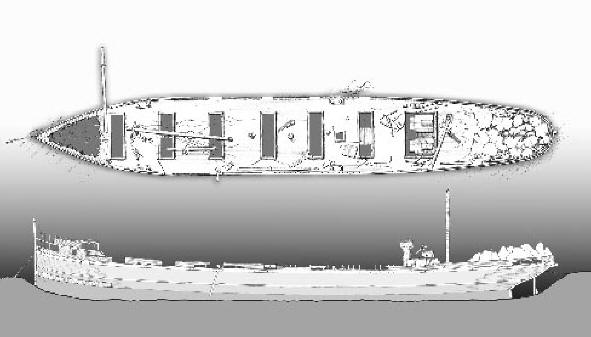
The wreck site clearly indicates that the H. C. Akeley sank stern first. The stern lies substantially deeper in the sand than the bow, and the orientation of the vessel and its scattered components provide evidence of the violent circumstances of the sinking.
The lower section of the mizzenmast lies perpendicular to the hull near its base, while the upper section rests along the port rail amidships. Much of its rigging remains scattered across the after deck.
The stern cabin, which likely provided shelter and access to the engine room, has disappeared. It may have separated from the deck as the stern plunged beneath the waves. A dark object visible off the starboard stern in side-scan imagery may be a portion of the missing cabin.
In place of the stern cabin, small mounds of hard, clay-like material cover portions of the after deck. These formations may represent a mixture of lake sediment and the vessel’s cargo. As the ship pitched sharply sternward during the sinking, the 54,000-bushel cargo of corn likely shifted toward the stern. When the vessel struck bottom, clouds of sediment may have enveloped the wreck and settled onto the deck, mixing with the displaced cargo.
The surrounding currents have created another unusual feature of the site. Sediment has not accumulated around the rudder and sternpost, which remain visible approximately 10 feet below the underside of the stern. Prevailing northwest currents scour the bottom beneath the vessel, exposing portions of the hull while depositing sand along the starboard side.
The sinking also caused extensive damage to the ship’s masts and rigging. As the stern plunged downward, the angle of the deck likely caused the remaining masts to break.
The mainmast lies parallel to the rails along the centerline of the vessel. Its top and rigging rest just behind the second hatch. The mast came to rest precariously on the capstan behind the third hatch. The topmast lies beside it, broken where it originally connected to the mast cap. The two sections span the area between the second and third hatches.
The foremast broke at its base and fell perpendicular to the hull across the starboard rail just behind the forecastle. It extends more than 20 feet beyond the rail.
The forward cabin, visible in the 1880 construction photograph, is also missing, along with the section of deck beneath it. The stern-first sinking may explain its disappearance. As the vessel descended at a steep angle, air trapped within the hull would have rushed toward the bow. The resulting pressure may have been sufficient to tear the forward cabin and deck completely away from the vessel.
Exposed hanging knees that once supported the deck remain visible. Below deck level, only scattered wood and metal debris can be seen. Amid the extensive destruction, however, two replacement window frames remain suspended from a hook on the port hull wall, apparently in nearly the same position they occupied when the vessel was still in service.
The overall condition of the wreck reflects both the violence of the November gale and the catastrophic nature of the sinking. Outer hull planking has disappeared from several areas. Only one hatch cover remains; the others were likely torn away as the vessel plunged through the storm.
Rigging, piping, planking, metal fittings, cooking vessels, and other debris cover the deck and surrounding lake bottom. Together, these remains provide a detailed archaeological record of the H. C. Akeley and the final moments of its crew.
More than a century after the storm, the wreck preserves physical evidence of a powerful November gale, a desperate attempt to save a stricken vessel, and the final resting place of a once-stout Grand Haven-built steamship.